Inside Kilifi's Baobab Studios
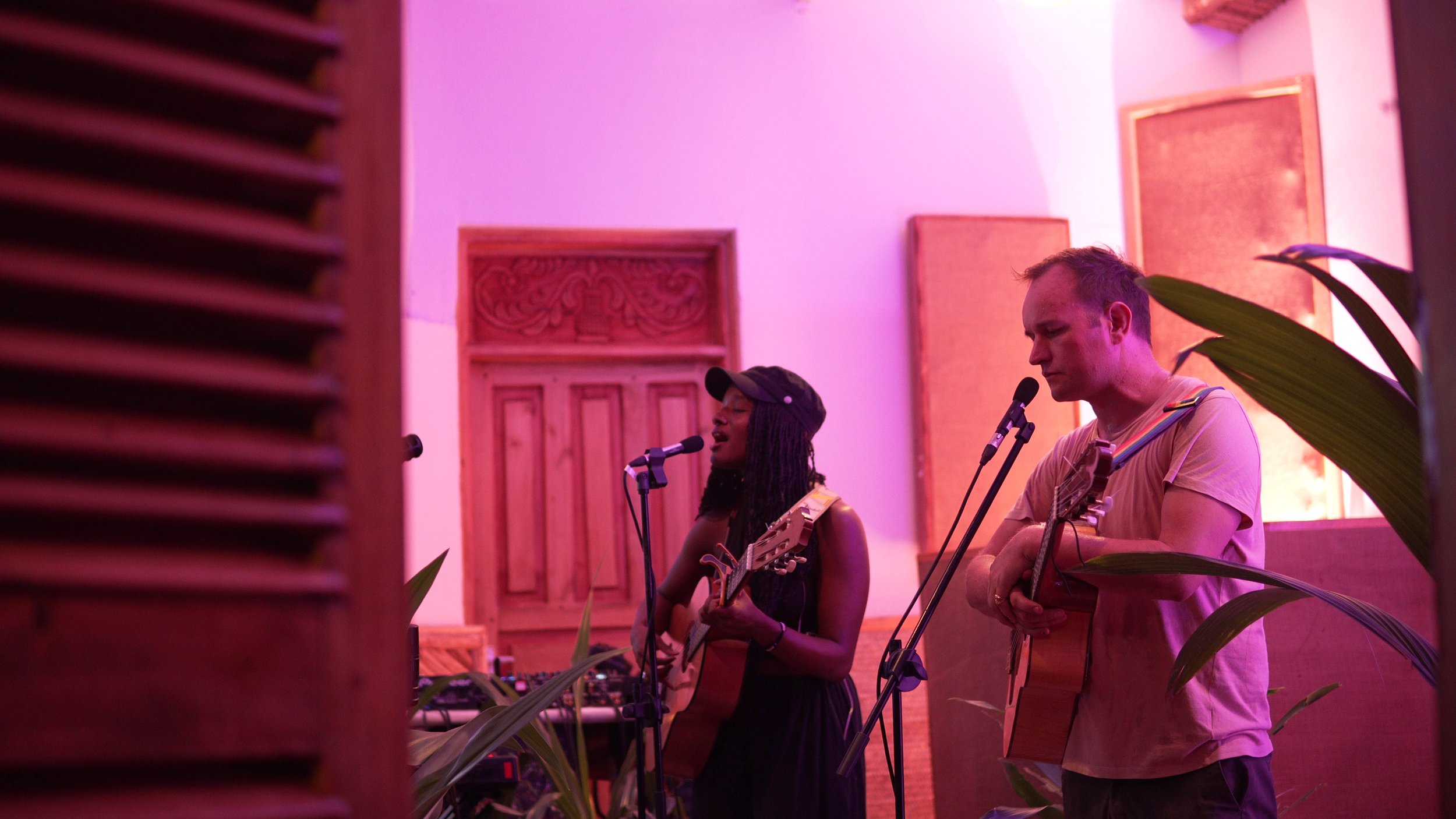
Pulsating yellow light threads through the trees, punctuating a way against the night. A tenor and a soprano rise somewhere ahead, acting as an invisible guide to the venue. It is a few minutes to 8 pm, on April 4th, 2025, and Baobab Studios is celebrating its first anniversary. The voices grow the closer I get. When I walk into the space, Kilifi-based folk duo Folk n Ether, comprising June on the Moon and Matt Swallow, are performing a song about love and floating. June’s voice lifts in the room, backed by her guitar and Matt’s harmonies. The space announces itself before it is even seen, offering a glimpse into how culture is being redefined in Kilifi.
The doors stand wide open. A tall wooden archway, intricately carved with Swahili flowers and vines, collapses the distance between forest and room. The studio is full to the point of intimacy. I find my spot amongst the people seated on the sprawling mkekas. There, between stretched and folded legs, we get lost in the night’s sonic offerings. Singer and multi-instrumentalist Musa Papillon floats onto the stage carrying a nyatiti and softens the room with a soulful delivery of his songs, among them a powerful rendition of Kothbiro. The music coming from the strings of his nyatiti and his haunting voice sounds familiar. I see why many refer to him as the protoge of Ayub Ogada. After his performance, the mood shifts, becoming more upbeat. As soon as Afro-fusion group Fanisi Band get on stage, the audience is on its feet. The band offers a reimagining of Mijikenda folk songs, breathing new life into them, punctuating the soulful mood set by Musa Papillon and giving us a reason to dance. Later, draped in his white kanzu, one of Coast’s revered lyricists, Kaa La Moto, takes the mic, singing Kenda, an unreleased song from the studio’s VA album. Kaa La Moto takes up space, and in this expansive moment he has created, he invites the audience to participate. He raps, and the audience joins in. I take a moment and take in the scene: the artist on stage, the audience around me, and the studio that holds us. It becomes clear, then, that the same walls that held these songs in their creation, rehearsal, and production are now holding the audience in their transformation.
As I listen to the music and take in the night, I am taken 420 kilometres away, to Nairobi, the place I call home, the place where my journey begins. In Nairobi, the sound is different, everywhere, all at once. There is music, but it doesn’t sound like this. And it doesn’t find me in places like this. It finds me everywhere, in the thick of traffic jams, in the middle of a hot, grinding day, in the many low moments, and in my weekend (mis)adventures. It feels natural that I would become a music writer, that I would want to write about the many sonic landscapes I find myself in. And it is this desire to be around music, and the realisation that the more I stay in Nairobi, the more the music feels closer to something like noise, that pushes me to leave, to immerse myself in something different. And so in late 2023, I chose to pluck myself from the city and plant myself in Kilifi to breathe, to expand my knowledge and appreciation of music, and to discover this coastal town through its culture and the faces behind it.
I arrived in Kilifi shortly after to work as part of the Beneath the Baobabs festival team. Leaving Nairobi had been a bit of a risk, but now it felt like everything had fallen in place. The timing could not have been more perfect as my arrival aligned with the launch of Baobab Studios. One of the first people I met was Karim, a creative born and raised in Kilifi, who works as the studio’s lead studio engineer. If the town is like its people, then this laissez-faire artist, with his encyclopaedic knowledge of placing sounds across genres, places and times, paints a perfect portrait of Kilifi. In one of our many conversations, he described Kilifi's creative scene to me. “Kilifi’s art scene has been put in the spotlight by very few artists, but the majority of the scene still lies undiscovered. From the traditional music to the urban scene, the talent is boundless.” When I ask bout what he feels about the studio’s presence in the town, his response is hopeful. We talk a bit about the music scene in Nairobi, and then he says, “Somehow away from the capital’s velocity, Baobab Studios has managed to take root.”
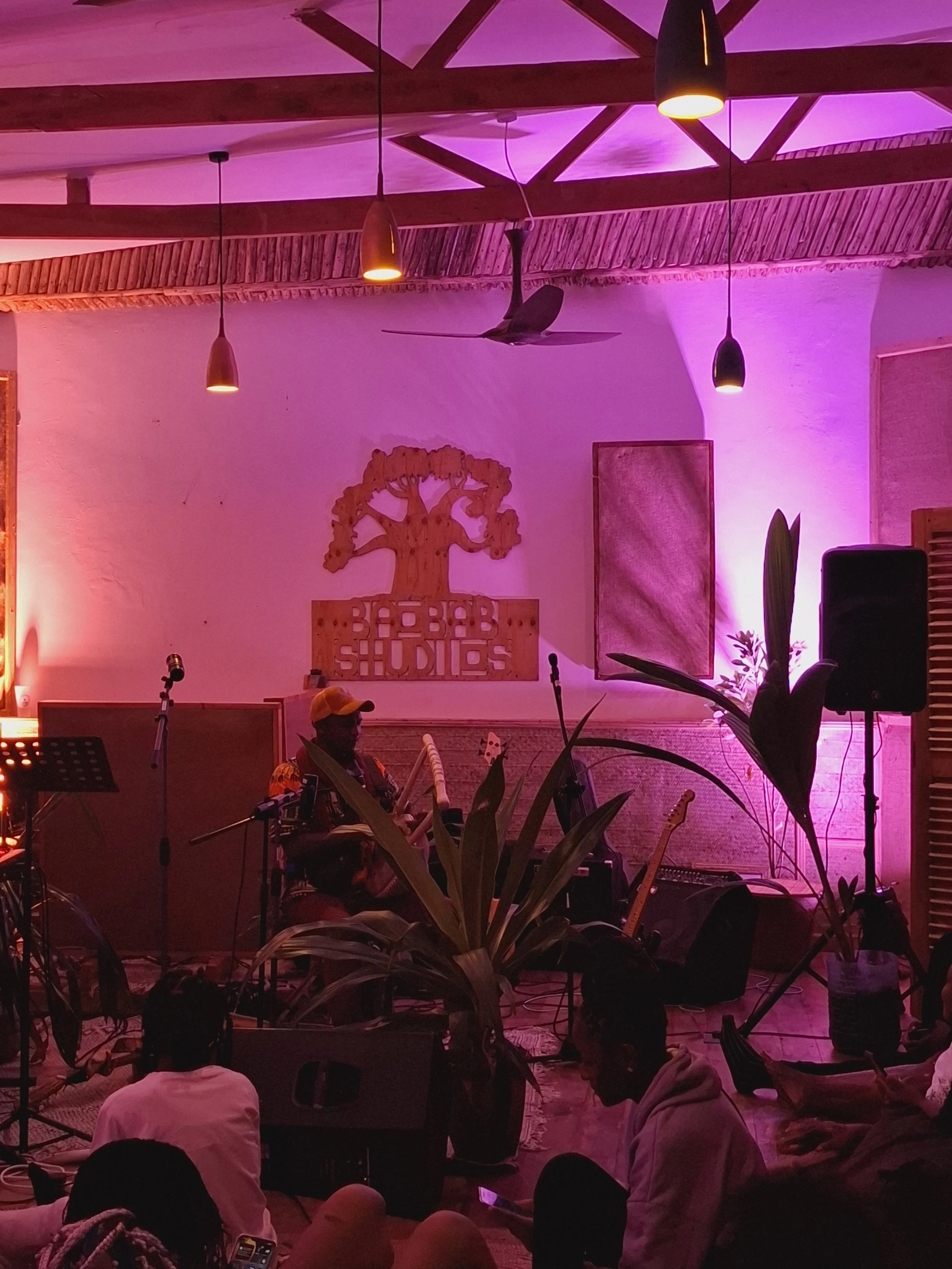
Launched in 2024 as a collective and studio by a small team led by its creative director, Matt Swallow, the space has opened itself to the expressive, experimental, and eccentric artists and audiences. As a space started by a British artist, it hasn’t gone unnoticed in a country where cultural infrastructure has often arrived with unequal power attached to it. Aware of its complicated and perhaps contradictory origin story, the studio strives to stay true to its vision: to be a home for “Baobab creatives” where community and collaboration are key even across differences. This is what I witnessed the following day after the anniversary event, when the studio had quietened itself from a space of performance into a space of practice.
Perched on a gentle rise overlooking the Takaungu valley, the studio extends itself off the land towards the verdant canopy beneath it. It is there on a sturdy wooden deck that Flava gives me a crash course on tuning Mijikenda drums. Under us, the terrain does its quiet work of seduction. Flava serves as the studio’s liaison and manager, dividing his attention between booking local acts, ensuring the equipment is well-maintained, and making music. At first glance, he looks the same age as everyone else in the room, somewhere between their late 20s and early 40s. It is only later that I learn that he is 50, the eldest person in the studio.
Under his guidance, I test my drumming skills on the drums: the mshondo and the chapuo. He explains the differences in the depth of the sounds, and I feel grounded in a way I had not expected. Hands on the skins, gazing in the distance, I surrender to the music and let nature settle me.
Inside, the stages from the previous night’s anniversary have been dismantled, and cables coiled away. The shutters rise and fall with the breeze from the valley, moving freely through a space returning it to its working shape. Karim is in the control room, moving patiently through layers of production equipment. Lemi, an energetic and charming young man, the kind you gravitate towards, pauses for a brief catch-up with Matt before settling into the keyboard set for another Folk n Ether band rehearsal. Nearby, June, who is also a resident intern currently developing work under ADA Records, sits with her guitar, strumming through ideas, stopping, starting again, deep in a kind of deliberate wandering. I move through it all, catching the room in motion. The air carries the patina of collaboration: artists booking sessions, tuning their crafts, learning by proximity, and exchanging ideas. Off-grid and closely tethered to nature, the studio draws its energy from its surroundings. As Lemi puts it, “that grounding gives us (the collective) room to experiment without losing our essence. It is a space where culture isn’t just referenced but lived.”
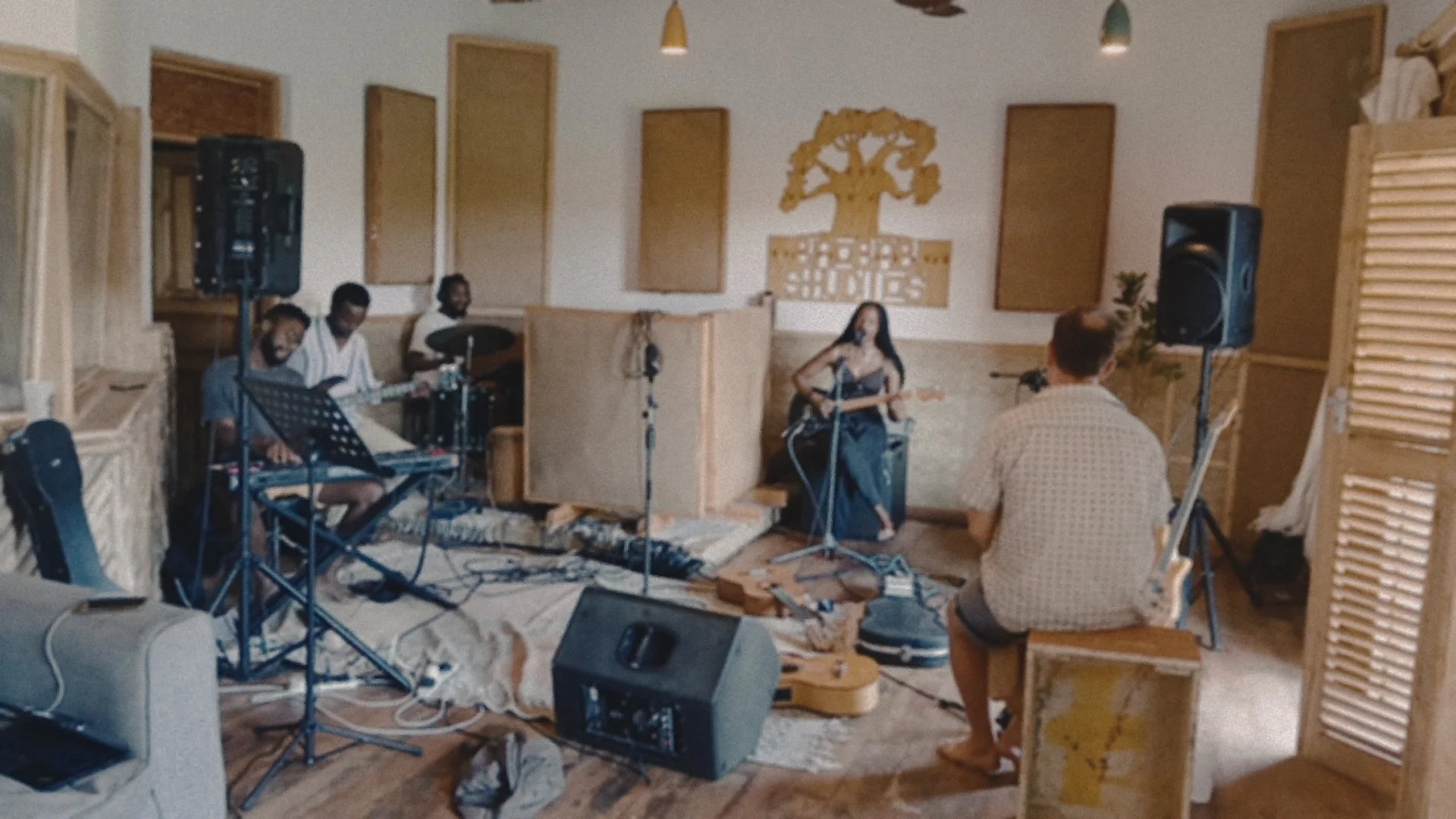
As I help move things around, speaking to these people I just met, I understand the care necessary when working with artists. Everything happening here is part of a long game, one that requires a lot of time and patience. As we are about to finish, Lemi, who manages artists and bookings, tells me about the importance of listening before making assumptions, the need to understand individual creative rhythms, and the necessity for clear communication and realistic timelines. This is a sort of freedom, structured to create room for openness without losing momentum.
This freedom allows for the untethered movement between modernity and tradition. Alongside cutting-edge recording equipment, sit locally-crafted drums made from cowhide skins stretched and cured under the Takaungu sun. That contrast isn’t merely aesthetic. It is also generational, a bridge between the past and the future, in a present where Flava has witnessed too many artists of his time disappear without the recognition they deserved.
The sound being made at the studio reflects the same logic, blending Mijikenda roots with contemporary production. As Karim puts it, “The Mijikenda sounds have inspired us to create various fusions of music that do not exist anywhere else in the world. This serves as an opportunity to experiment and create styles that are unique yet deeply rooted in Kenya.”
Some of the work emerging from Baobabs Studios does not shy away from addressing the issues in the community in which it exists. Take the song Uchawi si Mvi, for example, a song I first heard at the anniversary event performed by Kaya elder Mzee Tendere. In it, Mzee Tendere confronts the quiet violence of witchcraft accusations against elders in the Mijikenda community. The song won my heart for its earnest performance, which sounded like a reckoning in which Mzee Tendere carries the history in his body with grave authority. The song will be released later this April.
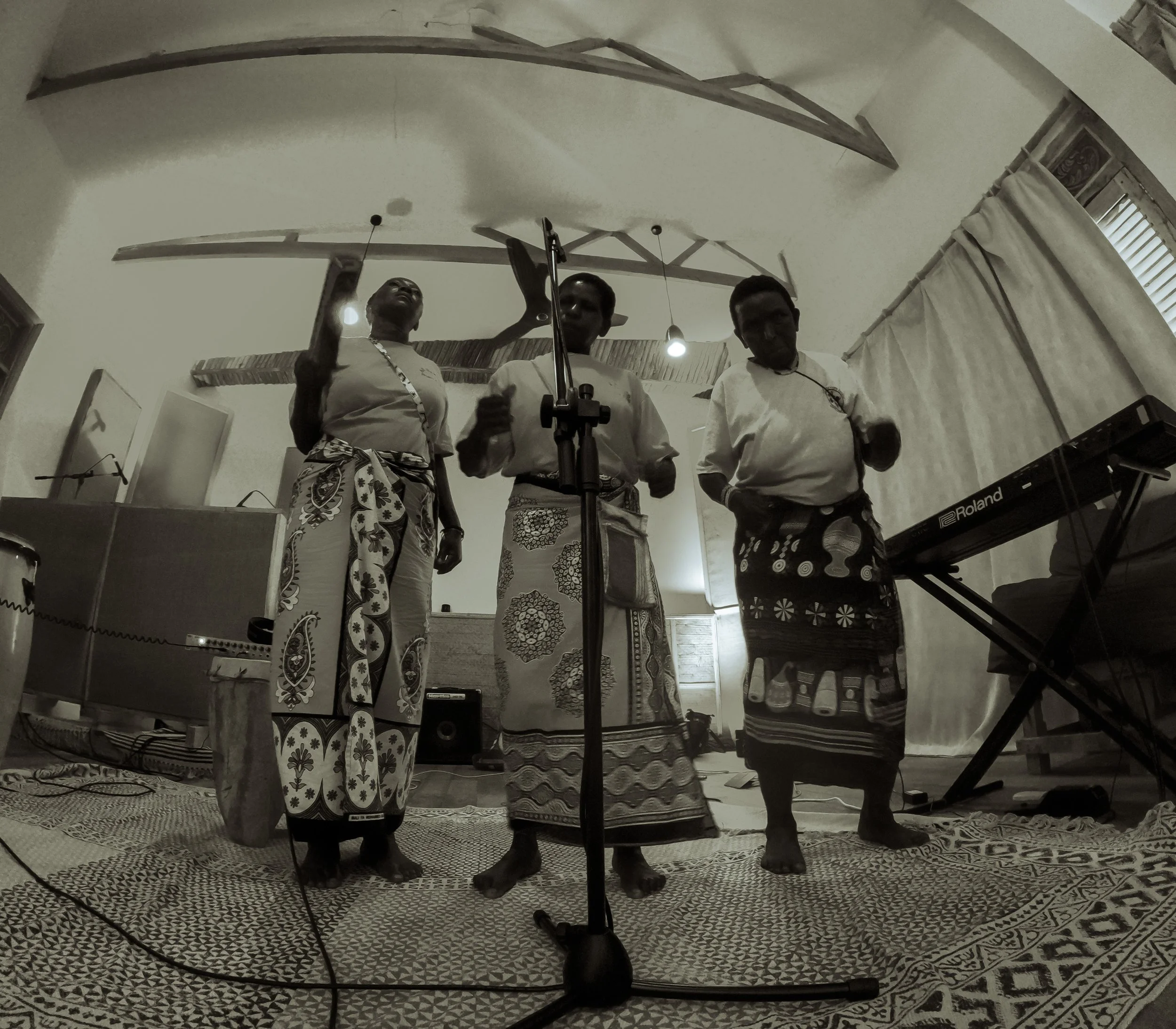
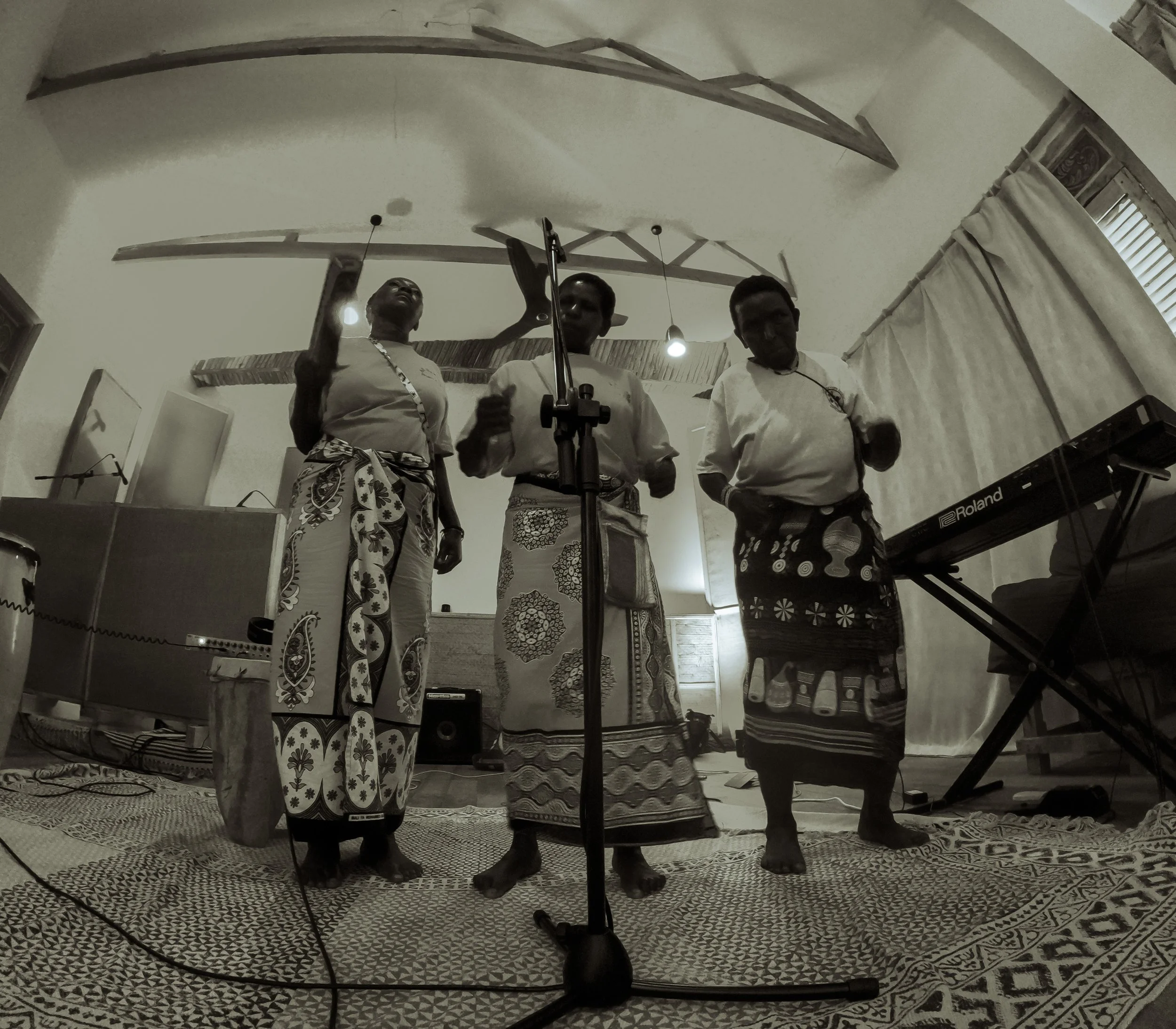
Recording studios in Kenya have, on occasion, played an important role in preserving culture. Here, where part of our heritage is carried orally through songs and rituals, the studio has been a space where what is shared earns the stamp of longevity. In the mid-2010s, Ketebul Music in Nairobi started an archiving project to document and release historical Kenyan music. Baobab Studios’ own contribution to this continuum takes shape through Lutsaga, an archival project dedicated to preserving the sounds of the Mijikenda community. The initiative was Flava’s brainchild with support from Malindi District Cultural Association (MADCA), and it involved a full ensemble of artists from the Mijikenda community making the space their own. The recordings offer us a chance to capture and archive the eternal shake of the kayamba, the depth of the drums during Kifudu, and the layered wisdom woven into Mwanzele. Flava states: “I have recorded cultural music before. Sadly, some of the great musicians I worked with have since passed on, leaving a gap in the cultural memory. That inspired us to take preservation seriously to safeguard our music and heritage for future generations.”
Because of the studio’s cyclical relationship with the wider festival ecosystem and its location on the same grounds as the annual Beneath the Baobabs festival, I found it impossible to focus solely on what had brought me to Kilifi. To be at the festival grounds is to be in the studio, and with its focus also on artist development through residencies, this is how I came to meet people who would change my perception of a place and its culture, and on the music that comes from it. This was also the place I would be reminded of how culture moves and how music unites us all. It is also the place that taught me how to listen, and maybe what I had learned here would be enough to help me make sense of a city almost unlivable, almost like this.